INFORMATION
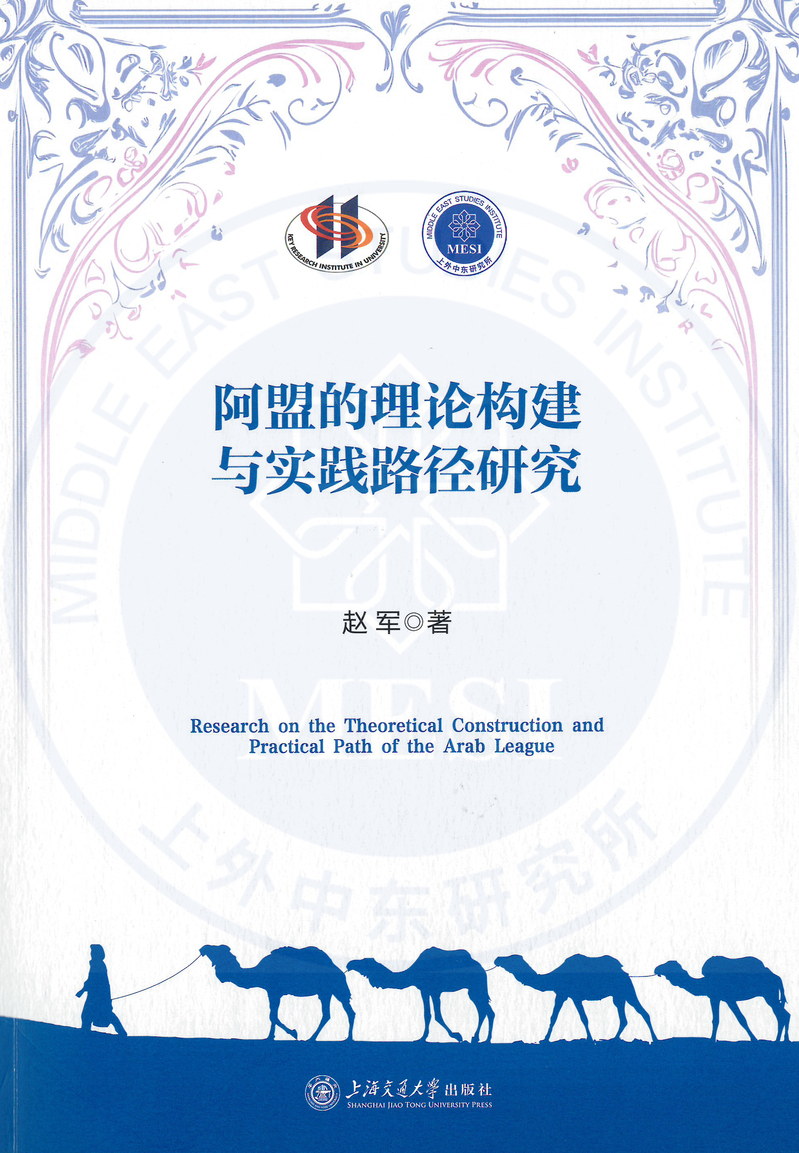
Name: Research on the Theoretical Construction and Practical Path of the Arab League
Author: Zhao Jun
Publisher: Shanghai Jiao Tong University Press
Publishing Date: April 2026
ISBN: 9787313340788
Pages: 353
INTRODUCTION
The ups and downs of the Arab League’s standing largely reflect its own resilience, the complexity of the Arab world, and the harsh realities of Middle Eastern politics. This book analyzes the organization’s tenacious vitality within a theoretical framework, exploring its unique logic of formation and practical experiences.
On the theoretical level, this book systematically examines the unique role of the Arab League in Arab integration from a regionalism perspective, proposing a dual-construction theory: the Arab League is both the institutional crystallization of Arab nationalism, possessing a distinct endogenous identity narrative, and continuously draws upon exogenous institutional norms from the United Nations, the European Union, and ASEAN, presenting hybrid characteristics where universality coexists with particularity, and progressiveness with stagnation. Its functional positioning of “equality, coordination, and self-discipline” enables it to aggregate issues, build consensus, and allocate resources through soft mechanisms even in the absence of supranational coercive power. This integration pathway characterized by “weak institutions and strong rituals” complements the rule-of-law model of the EU and the consultative model of ASEAN, filling the gap in regional integration theory regarding the Arab case.
At the practical level, this book conducts case studies across six major domains—politics, security, economy, socio-culture, energy, and foreign relations—to demonstrate that the Arab League is not incapable of achieving results, but rather that achieving them is exceptionally difficult. Structural challenges—such as low economic interdependence among member states, a lack of political trust, and deep-seated external interference—have persisted for a long time. Against this backdrop, the Arab League has shifted its focus to low-politics domains such as conflict mediation, standard-setting, and identity-building. It has developed an “Arab Solution” centered on forum diplomacy, statement-based politics, fund management, and cultural narratives, providing a viable pathway for the incremental provision of regional public goods.
The book’s academic value lies in using empirical evidence to refute the one-sided “theory of the Arab League’s failure” and to distill an “Arab League path” distinct from those of the EU and ASEAN; its practical significance aligns with the broader diplomatic needs of China and the Arab world. As Arab states enhance their strategic autonomy, the Arab League’s role as a regional collective voice and hub for cooperation becomes increasingly vital. A deep understanding of its institutional characteristics and behavioral logic has thus become a crucial prerequisite for China to advance pragmatic cooperation in the Middle East.
AUTHOR
Zhao Jun is from Shouxian County, Anhui Province. He is an associate professor at the Middle East Studies Institute of Shanghai International Studies University and the Executive Director of the Research Program on Arab Countries in Africa. He has long focused on Middle Eastern issues and primarily conducts research on contemporary Egypt, the Arab League, and China-Arab relations. He has published one academic monograph and over 30 papers in Chinese and English in academic journals both in China and abroad.
Table of Contents
Introduction
Section 1: Historical Context of Research on the Arab League
Section 2: Research Topics and Perspectives on the Arab League
Section 3: A General Assessment of Research on the Arab League
Section 4: Research Value and Main Content of This Book
Chapter 1: Regionalism, Regional Integration, and Arab Regional Integration
Section 1: Conceptual Understanding of Regionalism and Regional Integration
Section 2: Interpretations of Regional Integration from a Multidimensional Theoretical Perspective
Section 3: Major Types of Arab Regional Integration Practices
Section 4: A Theoretical Perspective on Arab Integration within the Framework of the Arab League
Chapter 2: The Institutional Design of the Arab League and Its Theoretical Functions
Section 1: Membership Criteria and Agenda Setting in the Arab League
Section 2: Key Norms and Principles of the Arab League
Section 3: Organizational Structure and Institutional Functions of the Arab League
Section 4: Decision-Making Procedures and Operational Mechanisms of the Arab League
Chapter 3: Practices of Arab Political Integration within the Framework of the Arab League
Section 1: Attempts at and the Current Status of Arab Political Unification
Section 2: The Arab League’s Pan-Arab Political Practices: The Tension Between Seeking Unification and Defending Sovereignty
Section 3: The Arab League’s Political Practices on the Palestinian Issue: From Unified Action to Divergent Positions
Chapter 4: Practices of Arab Security Integration within the Framework of the Arab League
Section 1: Major Mechanisms of Security Integration within the Framework of the Arab League
Section 2: Unified Action by the Arab League in the Field of Traditional Security—Taking Mediation as an Example
Section 3: Unified Action by the Arab League in the Field of Non-Traditional Security—Taking Counterterrorism as an Example
Chapter 5: The Practice of Arab Economic Integration within the Framework of the Arab League
Section 1: The Establishment and Turbulent Development of Arab Economic Integration Cooperation Mechanisms
Section 2: Arab Economic Integration within the Framework of the Arab League—Taking the Greater Arab Free Trade Area as an Example
Section 3: Major Obstacles to Arab Economic Integration within the Framework of the Arab League
Chapter 6: The Practice of Arab Electricity Integration within the Framework of the Arab League
Section 1: The Current Status of Arab Electricity Integration
Section 2: Cooperation Mechanisms for Arab Electricity Integration within the Framework of the Arab League
Section 3: Practical Progress in Arab Electricity Integration within the Framework of the Arab League
Section 4: Major Obstacles to Cooperation in Arab Electricity Integration within the Framework of the Arab League
Chapter 7: Practices of Arab Socio-Cultural Integration within the Framework of the Arab League
Section 1: Building Arab Cultural Integration within the Framework of the Arab League
Section 2: Building Arab Human Rights Protection Integration within the Framework of the Arab League
Section 3: Building Arab Rule of Law Integration within the Framework of the Arab League
Chapter 8: Unified Action Practices in Managing the Arab League’s Relations with Major International Actors
Section 1: The Establishment and Development of Relations between the Arab League and Egypt
Section 2: The Establishment and Development of Relations between the Arab League and Russia
Section 3: The Establishment and Development of Relations between the Arab League and China
Section 4: The Establishment and Development of Relations between the Arab League and the European Union
Section 5: The Establishment and Development of Relations between the Arab League and the United Nations
Chapter 9: Evaluation of the Theoretical Framework and Practical Pathways of the Arab League
Section 1: Characteristics of the Arab League’s Theoretical Framework
Section 2: Characteristics of the Arab League’s Practical Pathways
Section 3: The Arab League’s Challenges and Future Directions
Conclusion
Appendices
Appendix 1: The Alexandria Protocol
Appendix 2: The Convention of the League of Arab States
Appendix 3: Treaty on Cultural Cooperation Among Arab States
Appendix 4: Treaty on Joint Defense and Economic Cooperation Among Arab League Member States
Appendix 5: Charter for Arab Cultural Unity
Appendix 6: Arab Convention on the Suppression of Terrorism
Appendix 7: Arab Charter on Human Rights
Appendix 8: Chinese Policy Documents on Arab Countries
References