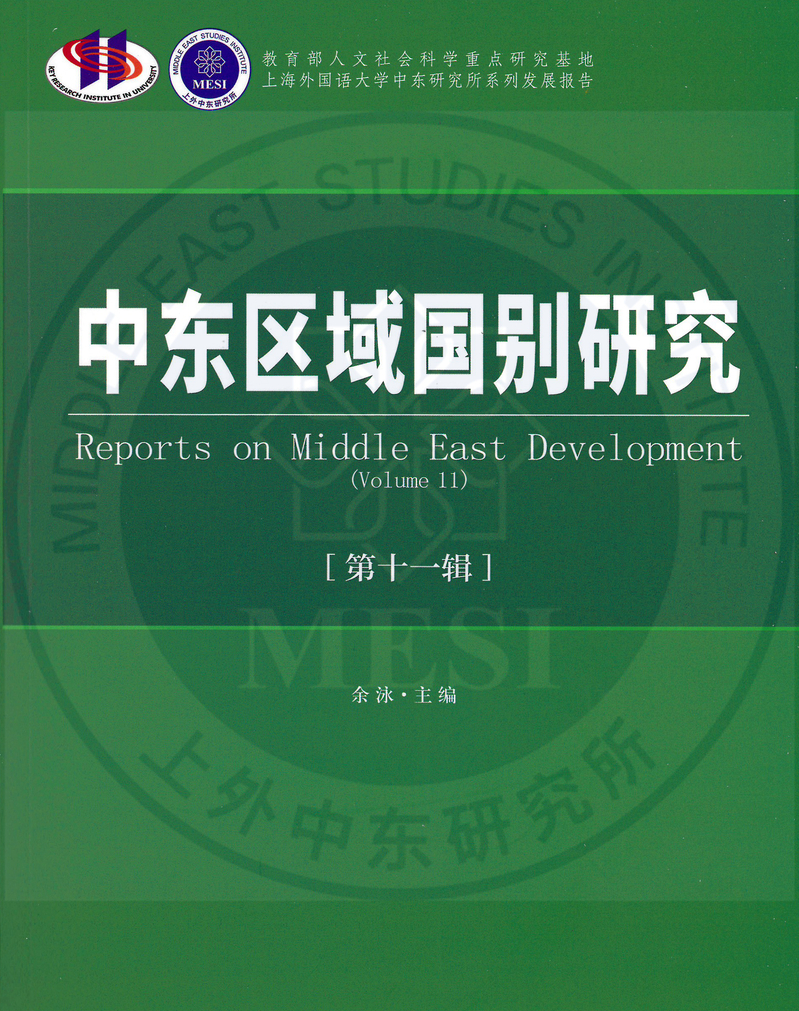
INFORMATION
Name: Reports on Middle East Development (Volume 11)
Series Name: Shanghai International Studies University Middle East Institute Series Development Report
Funding: Ministry of Education's Middle East Joint Research Institute Construction Program, Shanghai Universities First Class Think Tank Construction Project
Author: Yu Yong, Editor-in-Chief
Publisher: Current Affairs Press
Publishing Date: October 2026
Word Count: 450,000 words
ISBN:9787519507879
INTRODUCTION
From 2023 to 2025, the region witnessed a “wave of Middle East reconciliation” led by the restoration of diplomatic relations between Saudi Arabia and Iran following the “Beijing Agreement,” followed by a “wave of Middle East conflict” triggered by the “Al-Aqsa Flood” operation launched by the Palestinian group Hamas against Israel. The interplay between various geopolitical narratives, their spillover effects, and the international landscape has kept the Middle East region and its nations at the forefront of global political attention. At the level of domestic national development, the Arab states of the Gulf in West Asia have persistently pursued economic diversification and a balanced, multifaceted foreign policy, positioning themselves as representative members of the group of emerging nations and the “Global South.” However, the civil wars and governance failures in Arab nations such as Palestine, Syria, Yemen, and—in North Africa—Libya and Sudan provide vivid case studies illustrating the value of China’s “Four Major Global Initiatives.” During this period, major regional powers such as Egypt, Iran, and Turkey have been continuously advancing internal reforms, though the progress and outcomes of these efforts are far from optimistic; while the engagement of extra-regional powers such as the United States, Europe, and Russia has relatively diminished, countries like India have been paying greater attention to the region. The combined influence of these various forces will make the situation in the Middle East in 2026 even more complex and volatile.
Table of Contents
Main Report: Regional Situation
The Situation in the Middle East (2023⁓2025)/ LIU Zhongmin, XU Zhangmin
The Situation in West Asia (2023⁓2025)/ BAO Chengzhang
The Situation in North Africa (2023⁓2025)/ ZHAO Jun
China’s Middle East Diplomacy (2023⁓2025)/ LIU Shengxiang, LIU Qichen
Sub Report: Development of Representative Countries
Politics, Economy and Foreign Relations of Saudi Arabia (2023⁓2025)/ DING Jun, CHEN Jin
Politics, Economy and Foreign Relations of Iran (2023⁓2025)/·HAN Jianwei
Politics, Economy and Foreign Relations of Israel (2023⁓2025)/·NIU Song, SUN Yuan
Politics, Economy and Foreign Relations of Türkiye (2023⁓2025)/ ZHAO Jing
Politics, Economy and Foreign Relations of Five Gulf Countries (2023⁓2025)/ YU Yong
Politics, Economy and Foreign Relations of Iraq (2023⁓2025) /QIAN Xuming, WANG Shixuan
Politics, Economy and Foreign Relations of Syria (2023⁓2025)/ WANG Bo, MU Chunhuan
Politics, Economy and Foreign Relations of Lebanon (2023⁓2025)/ ZHANG Hanwen
Politics, Economy and Foreign Relations of Jordan (2023⁓2025)/ ZHANG Yuan, Shan Shuo
Politics, Economy and Foreign Relations of Yemen (2023⁓2025)/ WEN Shaobiao
Politics, Economy and Foreign Relations of Cyprus (2023⁓2025)/ HAN Yuxin
Politics, Economy and Foreign Relations of Egypt (2023⁓2025)/ LI Yi, TANG Ying
Politics, Economy and Foreign Relations of Algeria (2023⁓2025)/ SHU Meng
Politics, Economy and Foreign Relations of Morocco (2023⁓2025)/·LI Chaofei
Special Report: Regional Organization Development and Cutting-Edge Research
The Organization of Islamic Cooperation (2023⁓2025)/DING Long
The League of Arab States (2023⁓2025)/ ZHAO Jun, CAO Zhibo
The Gulf Cooperation Council (2023⁓2025)/ HAN Jianwei, YANG Qi
Food Security in the Middle East and Its Governance/ ZHANG Shuai, JIANG Yushan
The New Policies and Characteristics of Environmental Governance in Egypt/·KONG Yan, WANG Jingwen
Overview of Livelihood Development in the Kurdish Region of the Middle East/·MU Chunhuan